If you guessed China’s heavy lifter failed due to a liquid hydrogen turbo engine fault, well done! - theregister
Late 2018 launch plan for third attempt at moon-capable rocket
If you guessed China’s heavy lifter failed due to a liquid hydrogen turbo engine fault, well done! - theregister
Late 2018 launch plan for third attempt at moon-capable rocket
Remember that amazing video about SpaceX reusability back around 2011? It depicted that very thing.
Here’s a guy talking about the difficulty of recovering the second stage.
It seems far more aligned with the design of the stage to keep the accelerations in one direction, to land engine-first, and to use that vacuum engine in atmosphere, despite its reduced efficiency. The challenge, then, is surviving the aerobraking.process, and SpaceX may be looking at inflatable heat shields. A really good aerobrake would keep the stage alive, and would reduce the demands for fuel.
That all assumes that the vacuum engine can provide greater than a 1:1 thrust:weight ratio at sea level on whatever is left of the second stage.
This semester I reverse engineered the falcon 9 for a class project. I used what we know about the dimensions of the rocket and tanks and the density of the materials to get the mass data. I’m pretty confident that it’s in the ballpark(within 5% error. I’m not using supercooled propellants and I can’t really know the mass of electronics and anything else they add that aren’t the big ticket items).
S2 is pretty light when dry only around 3800-3900 kg. Merlin is only 470 kg, and I used ~400 kg for the mounting bracket. The rest of the stage is all tank and PMA. Looking at my spreadsheet it should be surprisingly high.
At the end of our sim with nearly all the propellant burnt it looks to be about 52m up measuring from the first stage which looking at my model looks to be a little bit above the bottom of the oxidizer tank which is right around the middle of the stage. In fact, if you guys are interested here’s the graph of the CoM. The reference point used is 4.4m below the gimbals…so substract 3ish meters from the data to get where it would be on the real rocket measuring from the bottom of the engines. Stage separation happens at 141 seconds and is clearly visible when the CoM jumps.
I just realized this is when Dragon is attached so it’ll drop some. Eyeballing it looks like it should be somewhere inside the fuel tank. engine + mount ~900 kg. fuel tank ~1266 kg. Ox tank ~1580 kg. I didn’t actually add mass for PMA but that’s probably 50-200 kgish.

They could also enter head first and attempt the flip maneuver during reentry using RCS and get real world data and practice without risking BFR. I would waste a few stages just getting data on that in the first place.
Well this reentry balloon is all about reducing drag: I think it might actually work too, and much better than a heat shield. If that tech works on BFR, it’ll further improve the costs. Imagine if you only ever had to replace engines and the balloon on the BFR every now and then. And the heat shields just never get used except if the balloon fails.
It would save money, probably, and it would make it safer if the system can be designed to recover if the balloon fails in any situation.
Skyentist, what are you studying and at what level?
The balloon system could work with S2 because it’s relatively light masswise. The BFR is huge and very massive. I don’t think the system will scale if it does work but hey it might. You’d just need an absolutely massive balloon. If we’re getting fancy I think the magnetic drag chute is a better idea for such a large vehicle where you have more mass to spare.
During reentry you have ionized gasses from the shock that forms around the vehicle. If you have a large enough magnetic field you can artificially extend the boundary/area of the shock creating a larger surface area and more drag just by manipulating a magnetic field. You just need large enough magnets and you can create your own magnetic parachute. It’s a really cool idea.
Masters in Astronautical Engineering
They could enter head-first, but it means evaluating the stage’s performance while upside down, then rightside-up again. And how did BFR get involved here? I think BFR is planning on a more shuttle-like reentry, with the large frame of the ship providing the greater surface area needed.
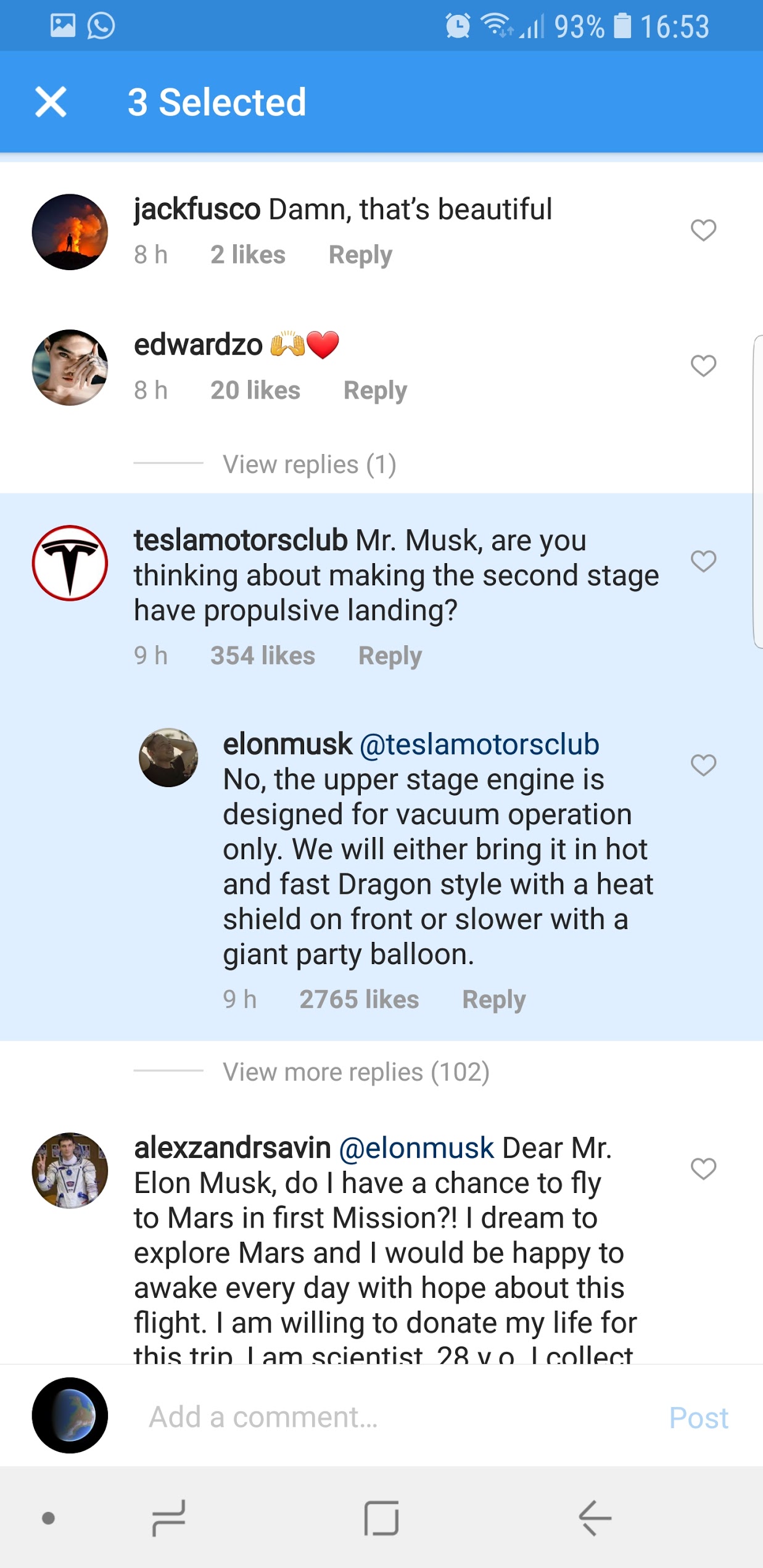
The balloon is a heat shield.
The Dragon heat shield is rated at 1850 C because of its relatively small surface area. Dragon plunges deeper and faster into the atmosphere, producing significant heating.
An “ultra low ballistic coefficient” heat shield is rated at 1100 C (ceramic fabrics) because it has a relatively large surface area courtesy of its being inflatable. The vehicle slows faster in the upper reaches of the atmosphere, preventing the higher heating that Dragon would experience. But it still has to provide a heat shield function.
Note that the University of Maryland system is not a balloon, but an umbrella. It has a rigid frame that deploys a fabric shield. So there are all sorts of ways of getting a heat shield between your ship and the atmosphere.
Right I should have mentioned that bit was unrelated to the balloon idea. I was just spitballing for getting experimental data. I involved BFR because they do come in like a shuttle, but at some point they flip around and begin retropropulsion. I was saying it would be good to get some experimental data on how to flip a spacecraft like that during reentry and S2 would be an excellent candidate.
Question to the rocket specialists: would it make sense to use a ramrocket as first stage? Could the shroud be made light enough to not outweigh the performance gains in atmosphere?
If no, why exactly, and if yes, why hasn’t it been done so far?
I know it’s essentially a heat shield. I meant a traditional ablative or thermal soak heat shield.
It increases drag to reduce temperature.
Based on what I read, there hasn’t been enough research into the area to know how to do it. Here’s a couple pages on a NASA project that started in on researching the idea back around 2001. For me, the picture is the most interesting bit. It shows how it’s a bit like a rocket with an open top to allow air to enter, get compressed, and burned with the rocket fuel. I like the simplicity of that over something like Skylon’s SABRE engine.
And the required Wikipedia page.
Note that the X-43B was supposed to explore Rocket-Based Combined Cycle propulsion techniques, but the X-43, a civilian project, was cancelled in favor of the X-51, a military project. The X-51 didn’t attempt to pursue RBCC technologies, and there hasn’t been any word on the X-51 since 2013.
Building off of JB’s answer it can also be attributed to the atmosphere and politics surrounding rocketry over the last half century.
Until the last decade or so aside from the select few corporations that are apart of the MIC there were not many organizations that manufacture launch vehicles or satellites. The only demand for those satellites were for military purposes and for communication(Still similar to now though).
There was no push from either the manufacturers or the customers to reduce costs and that large upfront development cost is a huge barrier to entry for spaceflight. When you have such a huge upfront cost decisions were made to spend it on what works rather than try something risky like any sort of deviation from the 2-3 stage recipe that still is dominant today.
What we had with ULA was a legitimate monopoly on US government launches and they also performed pretty poorly worldwide in the commercial market due to their large costs, but that didn’t matter because they could sell Atlas V’s and Delta IVs for 250-500 million a pop to government on top of a $1 billion a year subsidy for launch readiness. There was no competition to promote innovation.
If the current trends of falling costs to orbit and increased interest(anecdotal) in spaceflight we seem to be heading in a direction where, soon enough, companies will begin investing in these risky new launch vehicles(ex: BFR and Skylon).
The reduction of cost is what has allowed the vast majority of what we’ve seen to happen. You can go on rocketlabs website right now and book a rideshare for a cubesat with a fancy gui. You can do a lot with a 12U cubesat and it “only” costs a million to launch it. Though it may only be 20-30 kg which is ~ $50k/kg putting a complete satellite into orbit for that little is unreal. As more and more players get into the game competition will brew to drive down costs and find new technologies that could give you an edge. That’s the hope anyways. The key to all of this is that the cost to orbit needs to be driven down.
On top of that there is still a lot of research to be done for engines that can propel craft up to Mach 5 let alone past it. Mach 5-6 is about the speed limit for ramjets and to go faster you’d need a scramjet. I don’t know much about either of them other than their operating speeds.
Max-Q for the Falcon 9 is between Mach-1 and Mach-2. That’s a lot of force on the rocket already.
That’s also why I’m skeptical - because to keep using the atmosphere you need to hit even higher velocities. It sounds like an engineering nightmare in comparison to a rocket.
Velocity taken on it’s own is meaningless. Dynamic pressure is determined by the combination of speed and atmospheric density.
Falcon 9 experiences max Q at those velocities between 12km and 15km altitude.
Skylon would be doing Mach 5+ at altitudes in excess of 25km where the air is less than a sixth as dense (0.05kg/m3 vs 0.3kg/m3).
Also, because it uses lift to counteract gravity and because of the efficiencies of using an air breathing engine it can climb to those altitudes in a more sedate manner, never experiencing anywhere near the dynamic pressures experienced by traditional rockets.
Given 1/6th the density but 2.5x the speed, the SCRAM will have slightly worse drag with the subsonic equation. I confess that I don’t know how that changes for supersonic, and then hypersonic, but generally things get worse the more extreme you go.
Edit: completely forgot why I said that, haha. Faster gets worse (subsonic, again), and three’s also time at Max Q. IIRC, the falcon heavy only spends about 10 seconds in that realm, where I assume this would spend longer.
Personally, I’m more interested in how much more efficient this will really be: won’t we have to go conventional (jet) into ram into scram into rocket?
Sabre does not have a scramjet regime. I think it’s basically a turbojet until it switches to rocket mode.
REL’s major advancement is the precooler which can effectively cool the hot air you get after decelerating hypersonic intake - That’s the tech that no one else has cracked yet.
This means everything after the intake is subsonic so the engine doesn’t have to have separate turbojet/ramjet/scramjet ‘modes’ and the complexity and weight of a ‘3-in-1’ engine.
It does have some little ramjets in the bypass stream but their purpose is to mitigate the drag induced by air which bypasses the precooler, not to provide net thrust.
Also note it has variable intake geometry which I guess is to mitigate drag at the various speeds.
Regarding time spent at max Q, a Boeing 787 sustains max Q for its entire cruising regime (17 hours between Los Angeles and Singapore). There is nothing magically evil about max Q. It’s just an attribute of any given flight profile.
As you said, it all just comes down to efficiency.
I want to note that max Q is just that, maximum Q. It happens once in the flight typically around the transonic region while shocks are forming on the front of the vehicle(and outer surfaces in the cases of boosters, legs, grid fins, etc). Once the vehicle passes the transonic region the coeffecient of drag the vehicle typically decreases if the vehicle is designed with supersonic flight in mind.
Just because I know someone may bring it up, this happens when the falcon is flying Mach whatever(1-3) but that’s with reference to the sea level speed of sound. At that altitude and pressure the speed of sound will change and the vehicle’s Mach Number(I like to think of it as the speed of information in the current medium) will be between .8-1.2, aka the transonic region, although it may be flying several times faster than the speed of sound at sea level.
Max-Q for a 747 is a lot lower than what Skylon should be.
Since it’s an air breathing engine, I still see it being a possible issue.
Article.
Mannequin Skywalker takes high ground on Bezos-backed rocket
Blue Origin test flight reaches 107km apogee and lands safely
Replay of New Shepard Mission 8 Livestream
Shorter version
It’s not rocket science! Actually it is, and it’s been a busy frickin week
Russia and China light blue touch-paper, stand well back.
Russia and China celebrated a pair of successful launches this week, with a Rockot booster placing Sentinel-3B into orbit while China’s Long March 11 lobbed five imaging sats into space.

So I was checking the replies on Instagram for one of the fairing parachute deploy pictures and came across this regarding the reentry and landing of the second stage.